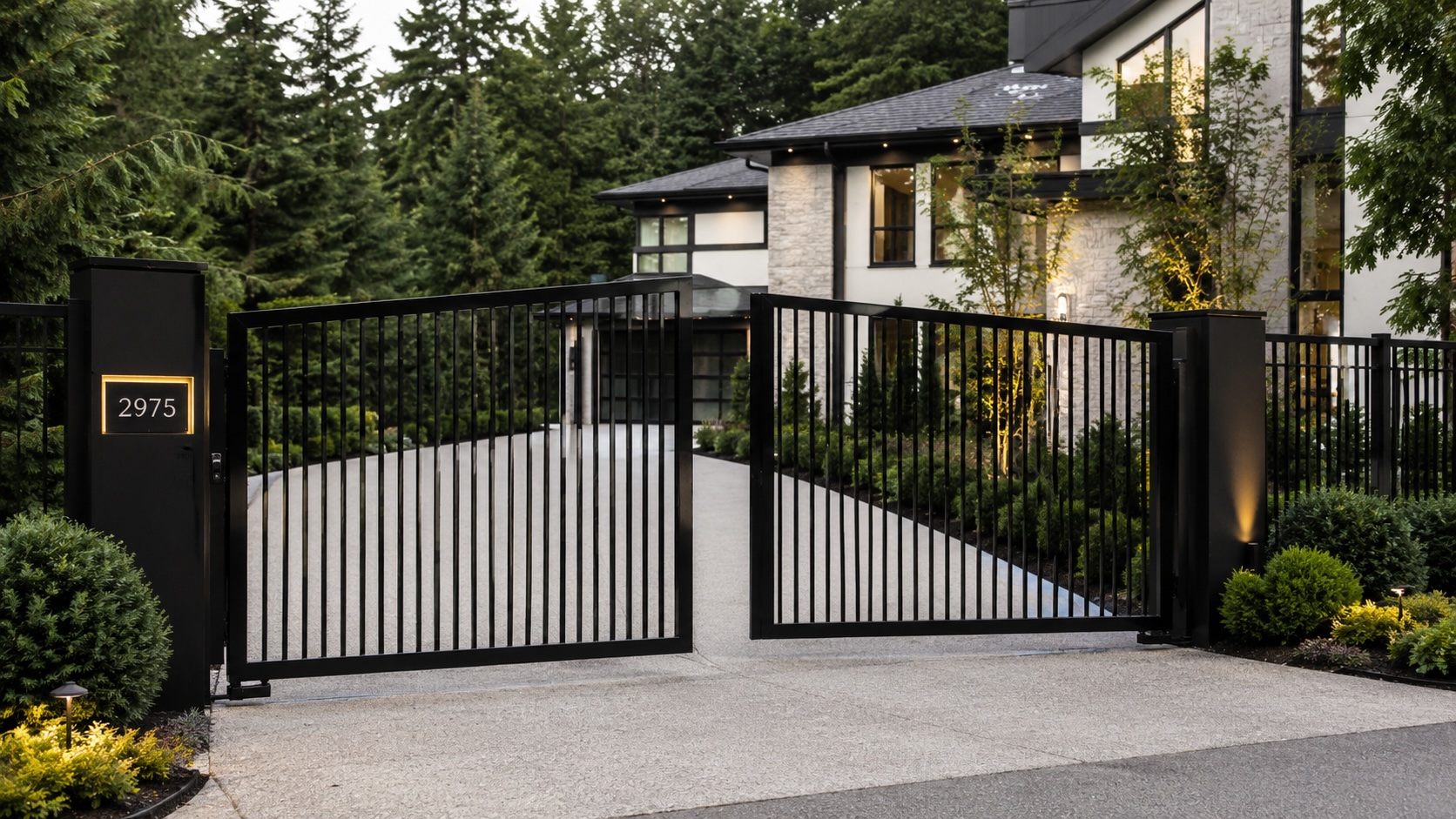


Sliding and swing driveway gates can both create a secure entrance, but they need very different site conditions. The best option depends on available space, driveway slope, vehicle movement, surrounding fences, and how the gate will be operated.
Homeowners comparing sliding gates with swing gates should start with the property rather than the gate style. A design that looks ideal in a photo may not suit a narrow driveway, steep grade, or limited side clearance.
How Sliding Driveway Gates Work
A sliding gate moves sideways across the driveway opening instead of swinging inward or outward. Depending on the system, it may travel along a track or use a cantilever arrangement that allows the gate to move without a ground track across the opening.
Sliding gates are often useful where there is enough clear space beside the driveway for the gate leaf to travel.
They can work particularly well when:
- The driveway slopes significantly
- Vehicle space inside the property is limited
- A swinging leaf would interfere with parking
- The entrance needs a wide opening
- Wind exposure makes a large swinging gate less desirable
The main planning question is whether there is enough unobstructed space beside the driveway. Fences, retaining walls, landscaping, utility equipment, and changes in grade can all affect the travel area.
How Swing Driveway Gates Work
Swing gates open on hinges much like a large door. They may use one leaf or a pair of leaves depending on the width and design.
A swing system can be visually simple and may require less side clearance than a sliding gate. However, it needs enough clear space through the arc of the gate.
A custom driveway gate should be planned around vehicle positions as well as the gate itself. A gate that technically opens may still be frustrating if a vehicle must stop too far from the entrance or back up before the leaves can move.
Swing gates often suit flatter properties with a clear opening area and enough room to accommodate the gate leaves.
Driveway Slope Can Decide the Question
Slope is one of the most important differences between sliding and swing systems.
A swing gate moving across a steeply rising driveway may run into the ground as it opens. The geometry can sometimes be addressed through design choices, but the site should be measured carefully before assuming a swing gate will work.
Sliding gates can avoid some of this conflict because they move laterally rather than sweeping across the sloped driveway. However, the area beside the driveway still needs suitable grade and clearance for the gate to travel.
Cross-slope also matters. Uneven ground can affect clearances, tracks, posts, and other components.
This is why driveway gate planning should include elevations and grade conditions, not only the width between two posts.
Which Gate Needs More Space?
Both need space, but in different places.
A sliding gate generally needs room beside the driveway, often at least comparable to the gate opening and sometimes more depending on the system.
A swing gate needs open space in front of or behind the gate. Double swing gates divide the opening between two leaves, which can reduce the swing radius compared with one very wide leaf.
Westline's guide on planning a custom driveway gate is useful for reviewing broader site considerations before settling on one mechanism.
What About Automation?
Both sliding and swing gates can potentially be designed as part of an automated entrance system, but the operator and related components need to match the gate configuration.
Automation planning should consider:
- Gate weight and dimensions
- Opening frequency
- Vehicle approach
- Safety devices
- Power availability
- Drainage and weather exposure
The gate structure, hinges or rollers, posts, and operator should be considered together. Adding automation after fabrication without planning for it can create unnecessary compromises.
Maintenance Differences
Sliding and swing gates have different moving components.
Track-based sliding gates need a clear travel path. Leaves, gravel, ice, and other debris can interfere with a ground track if it is not kept clean. Cantilever systems avoid a track across the driveway but still rely on rollers, guides, and structural support.
Swing gates depend heavily on hinges, posts, and alignment. Over time, movement in posts or supporting surfaces can affect how the leaves meet and latch.
For both systems, routine inspection should include:
- Gate alignment
- Moving hardware
- Visible fasteners
- Stops and latches
- Operator components if automated
- Drainage around posts and supports
Rain and coastal exposure throughout Metro Vancouver make drainage and appropriate exterior finishes particularly important.
Which Option Looks Better?
Appearance depends more on the gate design than the opening mechanism.
Both sliding and swing gates can use modern horizontal lines, more private solid sections, open metal patterns, or designs coordinated with nearby fencing.
A pair of swing gates can create a symmetrical entrance that some homeowners prefer. A single sliding gate can create a clean, continuous panel across a wide opening.
Looking through Westline's project gallery can help you think about proportions, finishes, and how a gate relates to the rest of the property.
Sliding vs Swing: Quick Comparison
Sliding gates may be better when:
- The driveway has a noticeable slope
- Space behind the gate is limited
- Vehicles park close to the entrance
- There is enough clear side space
- A wide opening needs to be managed efficiently
Swing gates may be better when:
- The driveway is relatively level
- Side clearance is limited
- There is enough room for the gate arc
- A hinged entrance suits the design
- The property layout supports one or two leaves
Neither list replaces a site review. Posts, foundations, drainage, grade, and access can change what is practical.
Choosing the Right Gate for Your Property
The most useful way to choose between sliding and swing gates is to map the movement of the gate and the vehicles using the driveway.
Measure the opening, look at the slope, identify side clearance, note where vehicles normally stop, and consider fencing, landscaping, retaining walls, and utilities. If automation is planned, include it in the design from the beginning.
Applicable safety, electrical, structural, municipal, and permit requirements can vary by property and system, so project-specific requirements should be verified before installation.
If you are planning a new entrance in Metro Vancouver or the surrounding service area, you can request an estimate from Westline with driveway photos, approximate measurements, plans, and information about the slope. That gives the project team a better starting point for determining whether a sliding or swing system suits the property.